Press and data
Our data studies on US credit cards, with the latest headline figures, downloads and a suggested citation for each. Every figure is calculated from Federal Reserve and New York Fed data, updates when they publish, and is free to use with credit. Reporters can email team@bestcredit.cards.
Press release · October 18, 2026
None of 137 sampled US credit cards offers a standard purchase APR at or below 10%, BestCreditCards finds
The lowest standard purchase APR in the sample is 10.24%. A historical illustration using end-2025 balances and the November 2025 APR of 22.30% gives a $535 annual interest difference at 10%. This assumes a constant balance for a year, not observed borrower savings.
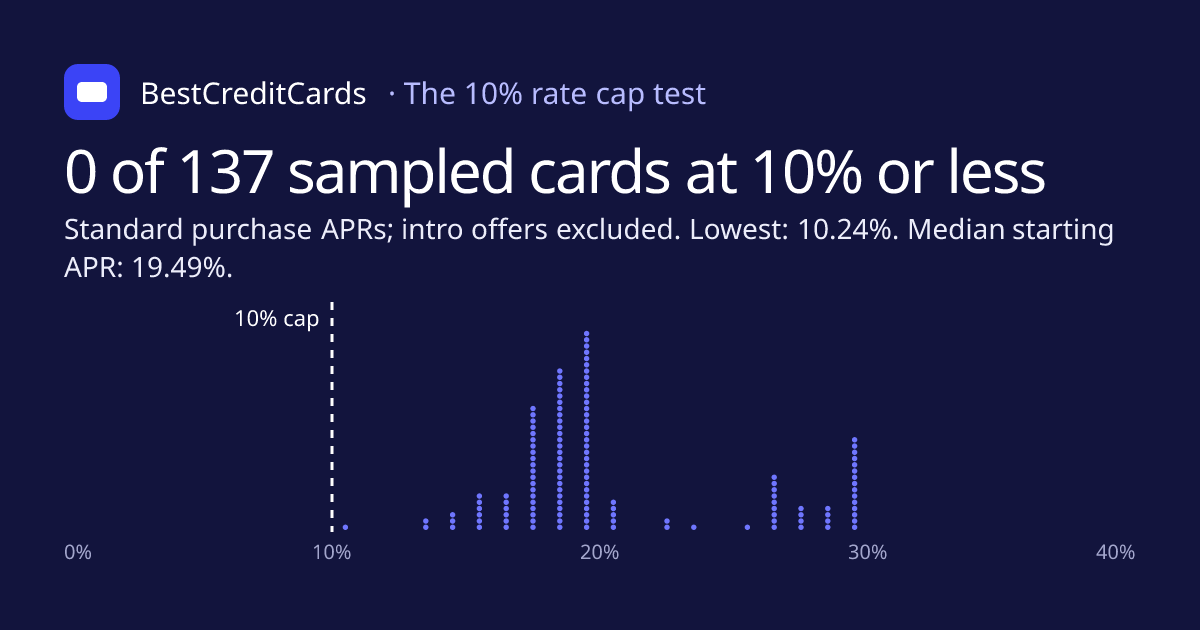
None of the 137 US credit cards tracked by BestCreditCards, an independent card comparison site, has a standard purchase APR at or below 10%, even for applicants with the strongest credit. The study compares the sampled cards’ published standard purchase APR ranges with a hypothetical 10% cap. The 10 Percent Credit Card Interest Rate Cap Act (S. 381) and the President’s January 2026 proposal both specify 10% but differ in duration. S. 381 remains at the introduced stage and has not become law. Its latest recorded action is referral to the Senate Banking, Housing, and Urban Affairs Committee on February 4, 2025. Legislative status checked October 20, 2026 against https://www.govinfo.gov/bulkdata/BILLSTATUS/119/s/BILLSTATUS-119s381.xml.
Key findings
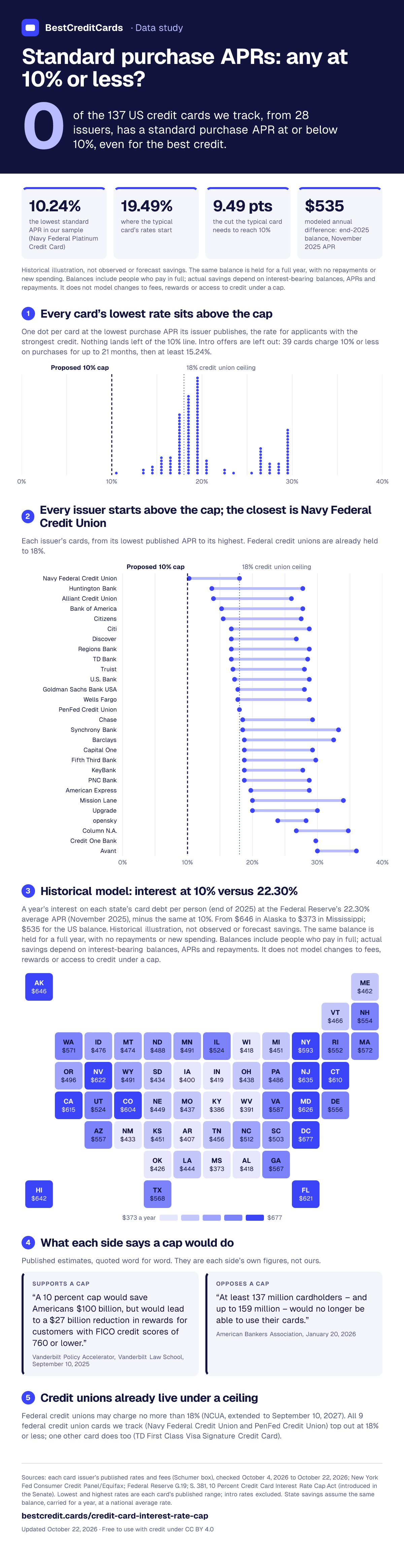
- None of 137 sampled cards has a standard purchase APR at or below 10%. They come from 28 issuers, including the largest. The lowest rate any of them offers is 10.24% (Navy Federal Platinum Credit Card).
- The typical gap is wide. The median starting APR is 19.49% and the median highest APR is 28.49%. To meet a 10% cap, the typical card would have to cut its lowest rate by 9.49 percentage points and its highest by 18.49.
- $535 modeled annual difference. The end-2025 balance was $4,350 per adult with a credit report. Held constant for a year at the historical 22.30% APR (November 2025), simple interest is $970; at 10%, $435. Historical illustration, not observed or forecast savings. The same balance is held for a full year, with no repayments or new spending. Balances include people who pay in full; actual savings depend on interest-bearing balances, APRs and repayments. It does not model changes to fees, rewards or access to credit under a cap.
- The modeled annual difference varies by state. It is largest in the District of Columbia ($677), Alaska ($646), Hawaii ($642), New Jersey ($635) and Maryland ($626), and smallest in Mississippi ($373), Kentucky ($386) and West Virginia ($391).
- Intro rates are temporary. 39 cards offer 10% or less on purchases for a while: 36 at 0%, and the Bilt Blue Card, Bilt Obsidian Card and Bilt Palladium Card at 10% for 12 months. Every one then reverts to a standard APR of at least 15.24%, the rate the cap would limit and the rate the study measures.
- Credit unions already have a ceiling. Federal credit unions may charge no more than 18%, a ceiling the NCUA has extended to September 10, 2027. All 9 federal credit union cards in the study top out at 18% or less; only one other card does.
What each side says
The study quotes both sides’ published estimates word for word and takes no side. The Vanderbilt Policy Accelerator estimates that a 10% cap “would save Americans $100 billion, but would lead to a $27 billion reduction in rewards for customers with FICO credit scores of 760 or lower.” The American Bankers Association says that “at least 137 million cardholders – and up to 159 million – would no longer be able to use their cards.”
Matt Woodley, editor of BestCreditCards, said: “When the Fed raises rates, your card rate goes up on the elevator. When the Fed cuts, your card rate takes the stairs.”
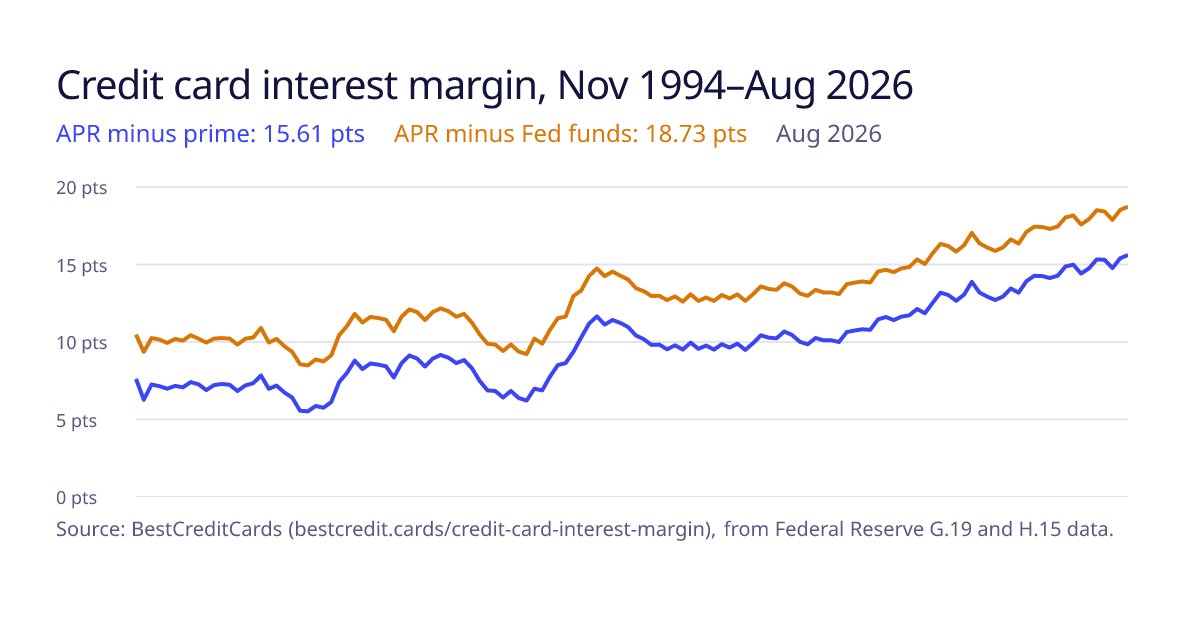
Federal Reserve data bear that out. The Fed funds rate fell 1.70 percentage points between August 2024, the last survey before the Fed’s first cut, and August 2026; over the same period the average APR on card accounts charged interest fell 1.01. In the cuts of 2007–09, the Fed funds rate fell 5.14 points and the average card APR fell 0.27. (BestCreditCards’ credit card interest margin study, https://bestcredit.cards/credit-card-interest-margin.)
Method
Card rates are each card’s purchase APR range as the issuer publishes it in its federally required rates table (the Schumer box), checked automatically against a saved copy of the issuer’s terms between October 4, 2026 and October 22, 2026 and re-checked weekly. State figures combine the New York Fed’s card debt per person (end of 2025) with the Federal Reserve’s average APR on accounts charged interest: a year’s simple interest at that rate and at 10%. They illustrate scale, not a forecast, and assume the same balances under a cap, which is what the two sides dispute.
Free to use
Every card and every state as CSV files, an embeddable infographic, a chart and a suggested citation are free to reuse under CC BY 4.0, with credit and a link: https://bestcredit.cards/credit-card-interest-rate-cap
About BestCreditCards
BestCreditCards (bestcredit.cards) is an independent credit card comparison site that publishes sourced, dated records of card fees and rates from issuers’ own disclosures. How it is paid is published at https://bestcredit.cards/how-we-get-paid. Matt Woodley is its editor. Media contact: team@bestcredit.cards.
Would any credit card pass a 10% rate cap?
Every US card we track, every issuer and every state against the proposed 10% APR cap, from issuers’ published rates and Federal Reserve data, with both sides’ estimates quoted. Updated October 22, 2026.
- None of the 137 US credit cards we track has a purchase APR as low as 10%, even for the best credit. The lowest is 10.24%.
- Half the cards start above 19.49%; the typical card would have to cut its lowest rate by 9.49 points to meet a 10% cap.
- On the average US card balance carried for a year, 10% instead of 22.30% would mean $535 less interest.
Download: Every card (CSV) · Every state (CSV) · Infographic (PNG) · Chart (PNG)
Cite as: BestCreditCards, “10% cap: standard US credit card APRs compared”, https://bestcredit.cards/credit-card-interest-rate-cap.
Credit card interest margin
A monthly index of how far the average credit card APR sits above the prime rate and the Fed funds rate, from Federal Reserve data back to 1994. Updated October 14, 2026.
- The average APR on US credit card accounts charged interest was 22.36% in August 2026, 15.61 percentage points above the prime rate.
- That margin over prime was 10.26 points in August 2016: it has widened by 5.35 points in ten years.
- That is the widest margin over prime in Federal Reserve data going back to November 1994.
Download: Monthly data (CSV) · Issuer margins (CSV) · Chart (PNG)
Cite as: BestCreditCards, “Credit card interest margin: card APRs vs the Fed, monthly”, https://bestcredit.cards/credit-card-interest-margin.
What the wider card margin costs in each state
Credit card debt per person, late payments and the extra interest from the wider margin in all 50 states and DC, from New York Fed and Federal Reserve data. Updated October 15, 2026.
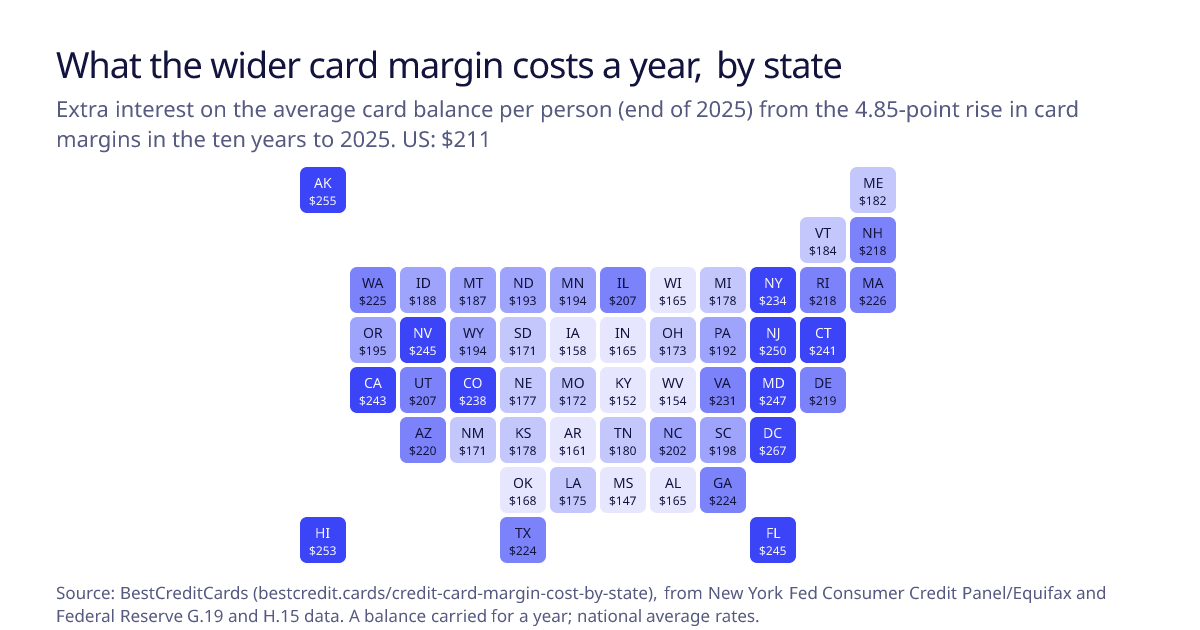
- On the average US card balance ($4,350 per person at the end of 2025), carried for a year at the 22.30% average APR of November 2025, the card margin’s 4.85-point widening over the previous ten years adds $211 in interest.
- Among the 50 states, card debt per person is highest in Alaska ($5,250) and lowest in Mississippi ($3,030).
- 12.4% of US card balances were 90 or more days past due at the end of 2025.
Download: Every state (CSV) · Map (PNG) · An image and sentences for each state
Cite as: BestCreditCards, “What the wider credit card margin costs in each US state”, https://bestcredit.cards/credit-card-margin-cost-by-state.
Credit card statistics
The Federal Reserve’s card series charted in full (debt, APRs, delinquency, charge-offs), report figures quoted from saved copies, and counts across our own card records. Updated October 28, 2026.
- Americans owed $1.35 trillion in revolving credit, mostly credit cards, in August 2026, up 3.4% on a year earlier.
- The delinquency rate on credit card loans at US commercial banks was 2.85% in the quarter starting April 2026.
Download: All series (CSV)
Cite as: BestCreditCards, “Credit card statistics 2026: debt per person, APRs, fraud”, https://bestcredit.cards/credit-card-statistics.
About BestCreditCards, for reporters
- Who we are: an independent credit card comparison site. Matt Woodley, our editor, is accountable for what we publish. About us.
- How we are paid: today we earn nothing from any card we list. How we get paid.
- How the figures are made: by code, from saved copies of official data, re-downloaded every week. Each study states its method and limits; mistakes go in our corrections log.
- License: our calculations are free to use under CC BY 4.0, crediting BestCreditCards with a link to the study. The Federal Reserve’s own figures are public.
- Logo: SVG · PNG, with the reversed version, colors and rules on our brand guidelines.


Questions, a figure for your area, or a correction: team@bestcredit.cards.
Approved for publication by Matt Woodley on October 20, 2026. Figures last changed October 28, 2026, read from the same data as each study. How we check every figure