Residual interest after credit card payoff
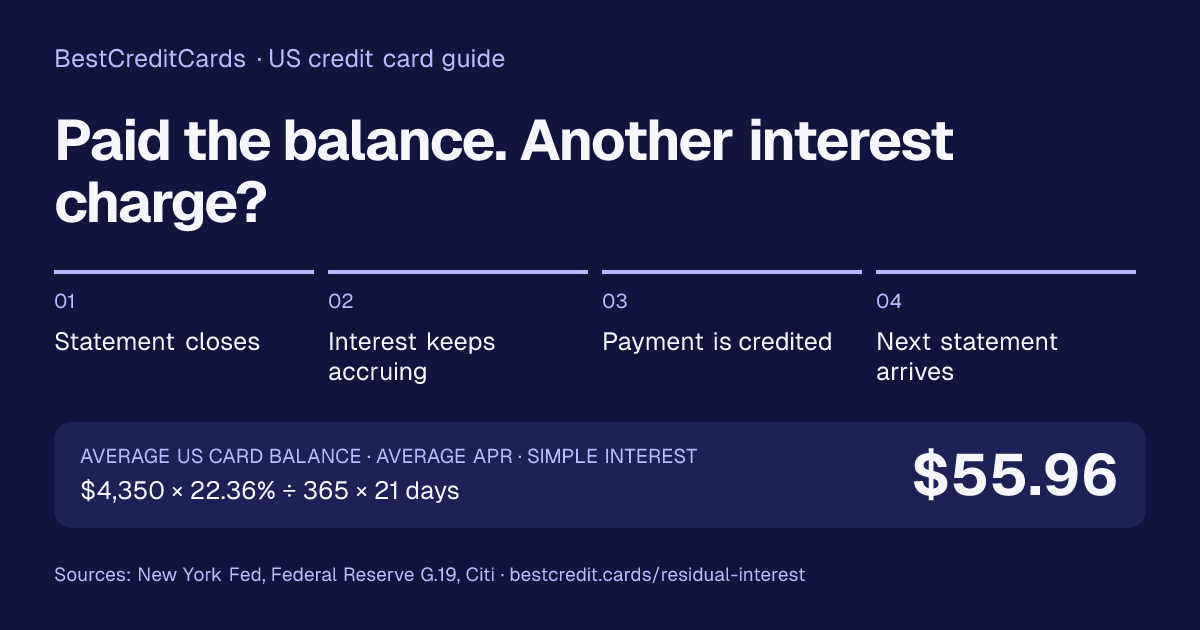
Residual interest, also called trailing interest, can build up between a credit card statement closing and your payment being credited. If you previously carried an interest-bearing balance, paying the statement balance can leave this unbilled interest for the next statement.
Accrued earlier. Billed later.
Why another interest charge can appear
- Statement closes
The statement records the balance at the end of the billing cycle.
- Interest keeps accruing
A carried balance without purchase grace can keep accruing interest before payment is credited.
- Payment is credited
You pay the displayed statement balance. Ask whether unbilled interest remains.
- Next statement arrives
Interest earned before the payment can now appear as a charge.
How is residual interest calculated?
A simple estimate multiplies the interest-bearing balance by the annual APR divided by 365, then by the number of interest-bearing days. This works as an illustration when the balance and rate stay constant; it is not an exact reconstruction of every issuer’s bill. (Sources: Capital One and Bank of America)
Illustration only, not your payoff amount. Assumes a constant interest-bearing balance, a fixed APR, a 365-day divisor and no grace period, new transactions, interim payments, fees, daily compounding or minimum interest charge. Your issuer’s method and payment-credit date can change the result. Inputs stay in your browser.
The worked example, step by step
Take the average US card balance, $4,350 per person with a credit report at the end of 2025 (New York Fed), at the Federal Reserve’s average 22.36% APR on accounts charged interest in August 2026. Paying on the due date leaves at least 21 days of interest after the statement closes, because issuers must allow at least 21 days between the two. (Source: Citi) Simple interest for those 21 days comes to about $55.96, with no purchase grace period and no other purchases, fees or payments.
The rate matters most. On the same balance and days, the standard purchase APRs on the 137 approved US cards in our records, from 10.24% to 35.99%, give between $25.63 and $90.07. Each card’s rate is checked against its issuer’s own terms; see our card comparison.
| Step | Calculation or assumption |
|---|---|
| Interest-bearing balance | $4,350: average card balance per person with a credit report, the end of 2025 |
| Daily rate | 22.36% (average APR on accounts charged interest, August 2026) ÷ 365 ≈ 0.061260% per day |
| Interest each day | About $2.66; use the unrounded rate in the calculation |
| Interest-bearing interval | 21 days: the minimum between statement closing and the due date |
| Estimated interval interest | $4,350 × 0.2236 ÷ 365 × 21 = $55.96 |
Your statement’s interest-charge section and agreement govern the actual calculation. Changing daily balances, different balance types, compounding, rounding and payment timing can make the charge differ from this simple estimate. (Sources: Capital One and Bank of America)
Why can a zero displayed balance still be followed by interest?
The statement records one billing cycle; it does not include interest that accrues after that cycle closes. A displayed balance can fall when your payment is credited, while interest from the preceding days has not yet appeared as a charge. (Source: Bank of America)
| Amount | What it tells you | What to check |
|---|---|---|
| Statement balance | The amount recorded when the statement was produced. | Interest accrued since that date can be billed separately. |
| Displayed current balance | The amount your issuer currently shows in the account. | Ask whether it includes all accrued but unbilled interest. |
| Issuer-confirmed payoff amount | An amount confirmed for settling the account, including relevant accrued interest. | Confirm the date, payment method and any remaining charges it covers. |
When paying off an existing balance, Citi advises asking the issuer for a current payoff that includes residual interest since the last statement. Do not assume an app balance is that quote. (Source: Citi)
How do you pay off residual interest?
Contact your issuer and ask for the amount needed to settle your account, including accrued but unbilled interest. Confirm when the payment must be credited and check the next statement for anything left over. (Sources: Citi and OCC)
- Identify the charge. Compare the statement dates and the date the issuer credited your payment. Ask which balance, APR and days produced the interest.
- Request a dated payoff. Ask whether the amount includes interest not yet on a statement, fees and any pending transactions.
- Confirm payment timing. Ask which method and deadline will credit the payment on the date used for the quote.
- Check the follow-up statement. Keep monitoring after payoff, transfer or closure. Query any remaining charge rather than assuming the account is settled.
- Ask separately about purchase grace. Confirm when new purchases will qualify for interest-free treatment again.
Questions to ask your issuer
“I previously carried a balance. What amount will settle the account, including accrued but unbilled interest, if my payment is credited on the agreed date? Could anything still appear on the next statement? What must I do to restore the purchase grace period?”
These questions help you obtain account-specific instructions; they are not a payoff quote. We do not suggest adding an arbitrary extra amount to the bill. If you believe a charge is incorrect, ask for the calculation and follow the billing-error instructions on your statement. (Source: OCC)
When does residual interest stop?
For the balance being settled, distinguish the end of interest accrual from the later date that interest appears on a bill. The issuer may bill interest for days before it credited the payoff; that later bill does not by itself mean the settled balance kept accruing interest afterward. (Source: OCC)
Restoring a purchase grace period is a separate question. The CFPB explains that losing grace can make new purchases accrue interest from their transaction dates. Capital One notes that a revolving balance may require full payment across consecutive billing cycles. That is not a universal rule for every issuer or account. Ask your provider what applies before making further purchases. (Sources: CFPB and Capital One)
Does statement-balance autopay prevent residual interest?
Autopay can help you pay on time, but paying the statement balance does not automatically include interest accrued since statement close. If you previously carried a balance, check the remaining payoff and grace requirements with the issuer. (Source: Citi)
If a purchase grace period applies and you meet its full-payment conditions, you can avoid purchase interest. Grace periods are not required on every card, and cash advances generally start accruing interest immediately. (Source: CFPB)
Can interest remain after a balance transfer or account closure?
Yes. A balance transfer can leave interest on the old account for the days before the transfer payment. Chase recommends checking that account for residual interest. Closing a card also does not remove interest already accrued: the OCC confirms that a closed account can still receive an interest charge for the period before payment was credited. (Sources: Chase and OCC)
To see what a transfer would cost you in fees and interest on each US card with a balance transfer offer, use our balance transfer calculator.
Can you ask for residual interest to be waived?
You can ask the issuer whether it will waive or adjust a charge. Do not treat the request as approval: ask what remains payable and follow the issuer’s instructions. If you think the calculation is wrong, request an explanation and use the billing-error process identified on the statement. (Source: OCC)
Is residual interest the same as deferred interest?
No. Residual interest concerns interest accrued before a payoff and billed later. A deferred-interest promotion can instead add interest back to the purchase date if its payoff conditions are not met. Check the promotion’s exact terms and end date; do not use the simple estimate here to calculate a deferred-interest bill. (Sources: Capital One and CFPB)
Sources, assumptions and how we checked this guide
This is general information for US cardholders. The worked example uses official averages, not your card’s terms or a personal payoff quote: the balance is the New York Fed’s credit card debt per person with a credit report (State Level Household Debt Statistics, the same data as our state-by-state page), and the rate is the Federal Reserve’s average APR on accounts assessed interest (G.19, via FRED; see our statistics page). The card APR range comes from our approved US card records. We retrieved the primary sources below on 2026-10-23; short supporting excerpts are saved and checked automatically, alongside calculation tests. Those checks do not verify your account or amount to a professional review.
| Source | What it supports | Retrieved |
|---|---|---|
| Capital One: Understanding credit card interest | Daily-rate calculation, carried balances, residual interest and issuer-specific consecutive billing cycles. | |
| Citi: What is residual interest? | Accrual through payment posting, the 21-day minimum between statement closing and the due date, and requesting a payoff including interest since the last statement. | |
| CFPB: What is a grace period for a credit card? | Purchase grace conditions, loss of grace, new purchase interest and cash advance exceptions. | |
| OCC: Can a bank charge interest and fees on a closed credit card account? | Account closure, interest before payment is credited and querying an incorrect charge. | |
| Bank of America: Credit card residual interest | The name “trailing interest”, daily accrual, later posting, illustrative approximation and monitoring further bills. | |
| Chase: Payment strategies after a balance transfer | Checking the old card for residual interest after a transfer. | |
| CFPB: How deferred-interest purchases work | Deferred interest differs from the ordinary statement-to-payment accrual window. |
Matt Woodley is the accountable editor; publication approval is shown below. We have not used these issuers’ payoff processes ourselves, and this guide is not a specialist financial review. Your agreement, account activity and issuer’s instructions determine your actual charges.
For broader context, see US credit card interest-rate and debt statistics. When you are ready to compare products, our US credit card comparison shows rates, fees and the catch. Rewards do not erase an interest bill.
Approved for publication by Matt Woodley on October 23, 2026. Primary sources retrieved 2026-10-23. Automated checks cover saved excerpts and illustrative calculations. Review interval: 90 days. How we check every figure